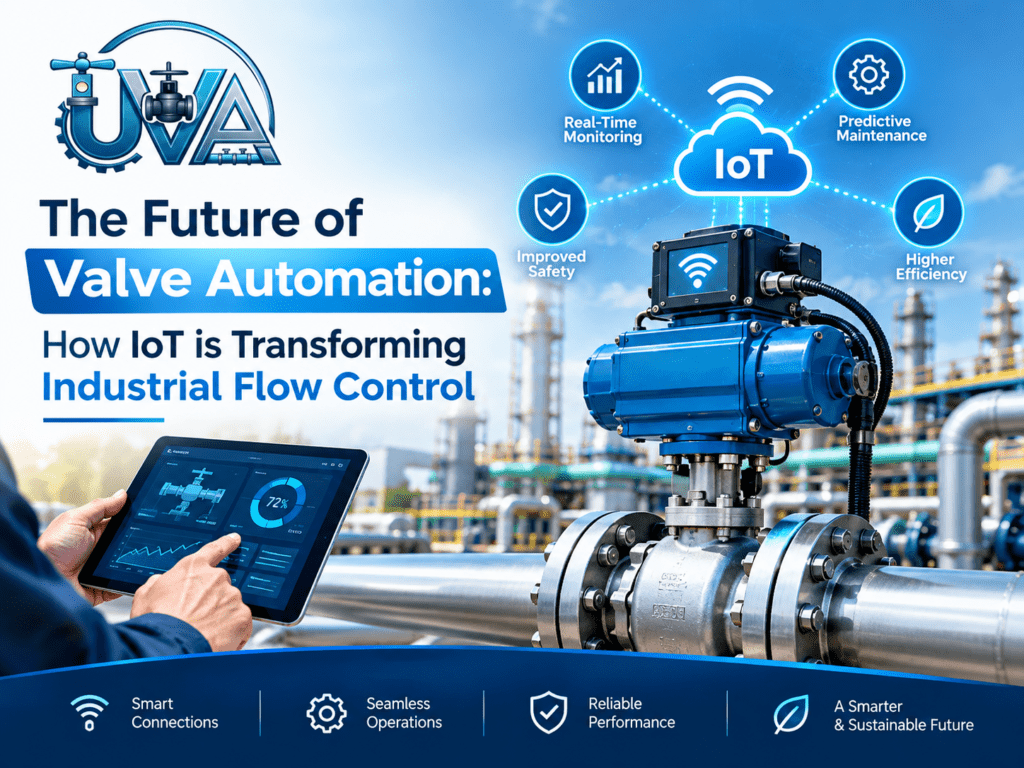
If you’ve been on a plant floor at all in the last few years, you might have seen something quietly changing in the background. Valves – those humble components that open, close, and modulate flow – are no longer just mechanical parts someone checks during a shift walk. They are becoming connected, data-producing assets talking to control rooms, mobile apps, and each other. This change has a name: smart valve automation, and it is rewriting the rules of how industries control flow, pressure, and process safety.
At Ultra Valves Automation Pvt. Ltd., we work with plant engineers and process managers every day who are asking the same question: is it time to move from manual and pneumatic valve setups to something smarter? In this article, we’ll walk through what this technology actually means, how IoT valve control systems work under the hood, why industries across sectors are adopting them, and what to consider before you make the switch.
What Is Smart Valve Automation, Really?
Smart valve automation uses sensors, actuators, connectivity modules and software to control, monitor and optimize industrial valves with little to no regular manual intervention. Instead of an operator physically walking the plant to see whether a valve is open, closed or partially throttled, that information is captured automatically and sent to a dashboard, SCADA system or mobile device in real time.
It helps to differentiate smart valve automation from simple automated actuation that has been around for decades. The pneumatic or electric actuator that opens and closes a valve on a fixed signal is “automated,” but not necessarily “smart.” Smart valve automation adds a layer of intelligence: sensors that measure torque, position, temperature, and vibration; onboard diagnostics that detect wear prior to failure; and communication protocols that push this data upstream so that it can be analyzed, logged, and acted upon.
In practice, most facilities move through three stages on the way to a fully connected valve setup:
- Manual operation – valves adjusted and inspected by hand, with paper logs or spreadsheets tracking maintenance.
- Basic automated actuation – electric or pneumatic actuators handle opening and closing, but there’s little to no data feedback.
- Smart valve automation – connected actuators, sensors, and controllers work together, feeding continuous data into a centralized system for real-time visibility and predictive decision-making.
Most plants we speak with are somewhere between stages two and three, which is exactly where IoT comes in.
How IoT Valve Control Systems Actually Work
The term “IoT valve control systems” can sound abstract until you break it into its working parts. At a basic level, an IoT-enabled valve setup includes four layers:
1. The sensing film. Sensors on or adjacent to the valve collect data points such as valve position, flow rate, pressure differential, temperature, and actuator health. They are the “eyes and ears” of the system.
2. The connectivity layer. This is what makes it an IoT valve control system rather than just an instrumented valve. Data from the sensors is transmitted – often wirelessly, sometimes over wired industrial networks – using protocols suited to plant environments so that information can travel from the field to a control platform without someone manually recording it.
3. Control and Analytics Layer. That’s where the smarts are. The software compares the incoming data to expected thresholds and either alerts an operator or initiates automated action. That layer can also run predictive models over time, flagging a valve that’s likely to fail in the next few weeks based on subtle changes in its behavior.
4. The integration layer. Finally, IoT valve control systems usually work in conjunction with other systems. They can be integrated with any control architecture a plant already has, whether it’s a SCADA system for centralized monitoring, a distributed control system (DCS) for closed-loop process control, or a programmable logic controller (PLC) for machine-level sequencing. A good smart valve doesn’t replace this infrastructure; it’s another set of eyes feeding into it.
The result is a valve that isn’t just a mechanical gatekeeper for flow but a live data point in a much larger operational picture.
Why Industries Are Making the Shift
Every plant manager has heard the pitch about “digital transformation,” and it’s fair to be a little skeptical of buzzwords. But the reasons for the increasing use of smart valve automation are quite concrete and tend to fall into a few consistent categories.
Reduced Unplanned Downtime
Unplanned downtime is costly. In continuous-process industries it can cost many times more than the price of the failed equipment. IoT valve control systems can detect early warning signs—a slight change in actuator torque, an unusual vibration pattern, a drifting positioner—long before those issues cause a shutdown. Instead of finding a stuck or failing valve during a scheduled turnaround, maintenance teams get an alert weeks in advance and can schedule the repair on their own terms.
Predictive Maintenance Over Reactive Repairs
Traditional maintenance schedules are based on fixed intervals: check the valve every three months and replace the seal every year, regardless of what the actual condition is. Smart valve automation turns the model on its head. The system is constantly checking real-world operating conditions so you can schedule maintenance based on actual wear, not a calendar guess. This means fewer unnecessary maintenance calls and less chance of missing a real problem between regular inspections.
Energy and Resource Efficiency
A valve that doesn’t seat properly, or one that “hunts” (oscillates instead of holding a stable position), wastes energy and raw material every single day it runs that way. IoT valve control systems enable accurate digital positioning, which allows for precise modulation, which translates directly into reduced energy use and reduced product waste in dosing and chemical processing applications.
Improved Safety and Compliance
In industries such as oil and gas, chemicals, and water treatment, a valve failure is not just a cost issue—it can be a safety incident. Automated shutoff valves that respond instantly to a detected leak or abnormal pressure reading shorten the exposure time to hazardous conditions. Regular monitoring also provides the kind of audit trail regulators are beginning to expect, making compliance reporting a lot less painful.
Remote Visibility Across Sites
Remote visibility is a huge selling point for organizations that manage multiple facilities or for teams stretched thin by the ongoing skilled-labor shortage in industrial operations. Engineers can check valve status, flow rates, and maintenance alerts from their laptops or phones instead of having to visit every site. Remote visibility doesn’t replace skilled technicians, but it lets them focus on their work. This technology means no need for skilled technicians, but that they spend their time where it is really needed. where it really belongs.
Smart Valve Automation is being utilized in various applications.
The versatility of IoT valve control systems means they show up in more places than most people expect:
- Oil and gas – pipeline monitoring, pressure regulation, and leak detection across long-distance infrastructure that would otherwise require constant manual patrol.
- Water and wastewater treatment – municipal systems use connected valves to balance supply, detect leaks early, and prevent issues like water hammer that damage pipe networks.
- Chemical and pharmaceutical processing – precise dosing valves ensure accuracy down to fractions of a percent, which matters enormously when a formulation depends on exact ratios.
- Power generation – steam and cooling systems rely on valves that must respond instantly to changing thermal loads.
- Food and beverage – hygienic valve automation supports both process consistency and the traceability records regulators require.
- HVAC and building automation – smart valves regulate water flow through coils based on temperature setpoints, cutting energy costs in large commercial buildings.
Across nearly all of these, the underlying logic is the same: replace guesswork and manual checks with continuous, reliable data.
What to Consider Before Adopting Smart Valve Automation
None of this means every valve in a facility needs an IoT retrofit overnight. A thoughtful rollout usually starts with a few practical questions:
Which valves matter most?
Not every valve carries the same operational risk. Start with the ones tied to safety-critical processes or the highest downtime cost if they fail.
What’s your existing control infrastructure?
Regardless of the type of system—SCADA, DCS, PLCs, or combinations of these—any new smart valve needs to be designed for smooth integration, not just another system for operators to control independently.
Do you need a retrofit or a full replacement?
Often, existing valves can be upgraded with smart actuators and positioners rather than replaced outright, which keeps costs down while still delivering most of the benefits.
How will your team use the data? Sensors and connectivity are only valuable if someone is actually looking at the dashboards and acting on the alerts. Part of a successful rollout is training teams to shift from routine manual checks to data-driven maintenance decisions.
At Ultra Valves Automation Pvt. Ltd., this is usually where we start the conversation with a client—not with a product catalog, but with an honest look at where automation will actually move the needle for their specific operation.
The Road Ahead
The direction of travel is clear. Industrial control valve technology has been evolving quietly for years, but the pace has picked up considerably as digital positioners, edge sensors, and AI-based diagnostics become more affordable and easier to deploy. Analysts tracking the overall control valve market indicate steady growth over the coming years, driven largely by industrial automation, aging infrastructure that needs modernizing, and a general push toward Industry 4.0 practices across manufacturing, energy, and water sectors.
What’s changing next isn’t just more sensors—it’s smarter interpretation of the data those sensors produce. Machine learning models are getting better at spotting subtle failure patterns, and as connectivity standards mature, integrating a smart valve into an existing plant network is becoming less of a specialized IT project and more of a standard part of instrumentation planning.
For plant managers and process engineers, the practical takeaway is this: smart valve automation isn’t an all-or-nothing decision, and it isn’t just for large enterprises with unlimited automation budgets. It’s a gradual transition that can begin with the highest-risk or highest-cost valves in a facility and expand from there, guided by real operational data, not a one-size-fits-all automation plan.
Frequently Asked Questions
1. What’s the difference between an automated valve and a smart valve?
An automated valve simply opens or closes based on a control signal, with little or no feedback. A smart valve, by contrast, includes sensors and connectivity that continuously report on its condition—position, torque, temperature, and more – allowing for monitoring and predictive maintenance rather than just remote operation.
2. Is smart valve automation only useful for large industrial plants?
No. While large continuous-process facilities see the most dramatic ROI, smaller operations benefit too, especially where a single valve failure can halt an entire production line or create a safety risk. Many facilities start with a handful of critical valves before expanding the rollout.
3. Do IoT valve control systems require a full network overhaul?
Not usually. Most IoT valve control systems are designed to integrate with existing SCADA, DCS, or PLC infrastructure rather than replace it. Often, a facility can retrofit existing valves with smart actuators and positioners instead of installing entirely new hardware.
4. How does smart valve automation improve safety?
By detecting abnormal pressure, temperature, or flow conditions in real time and triggering automatic shutoffs or alerts, smart valves reduce the time between a developing problem and a response. This is particularly important in industries handling hazardous materials, where delays can escalate quickly.
5. What kind of maintenance savings can a facility expect?
While results vary by industry and valve type, the general pattern is consistent: facilities move from calendar-based maintenance to condition-based maintenance, which typically reduces both unnecessary service visits and the number of unplanned shutdowns caused by valve failure.
Conclusion
Valve technology has quietly moved from a purely mechanical discipline to a data-driven one, and that shift shows no signs of slowing down. Smart valve automation isn’t about replacing skilled engineers with software – it’s about giving those engineers better information sooner so they can make faster and more confident decisions. Whether it’s a water utility trying to cut down on leaks, a chemical plant chasing dosing accuracy, or an oil and gas operator managing pipeline risk across hundreds of kilometers, IoT valve control systems are becoming the connective layer that makes modern flow control possible.
If your facility is weighing where to start, the team at Ultra Valves Automation Pvt. Ltd. is happy to walk you through your current setup and help identify which valves would benefit most from automation first. You can learn more about our approach and product range at www.ultravalvesautomation.com.