
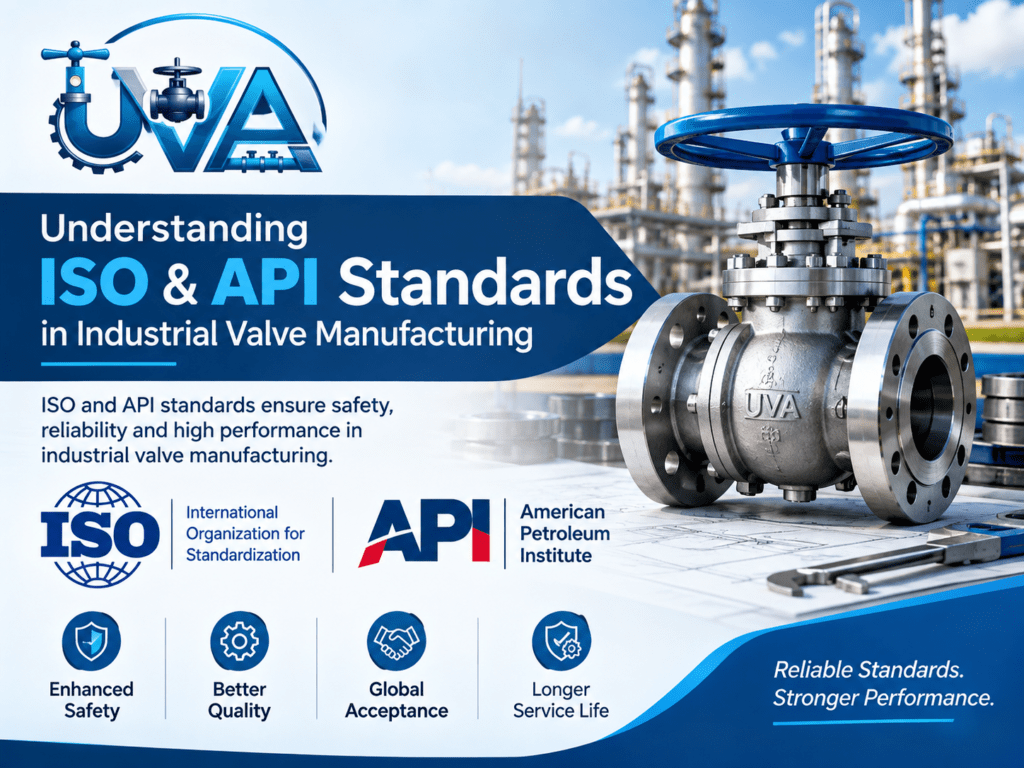
If you’ve done any time at all sourcing valves for a plant, pipeline, or process unit, you’ve surely noticed that every serious supplier throws around the same alphabet soup – ISO 9001, API 600, ASME B16.34, and API 598. It may sound like marketing BS until the day a valve gives way under pressure and you realize those letters and numbers were never for show. They were the difference between a holding valve and a non-holding valve.
At Ultra Valves Automation Pvt. Ltd. we are asked almost every day what these standards actually mean for a buyer – not for an engineer writing a spec sheet but for the one who has to sign the purchase order and live with the consequences. This guide breaks that down in plain language, focusing specifically on two things that come up over and over again: what it means to buy ISO-certified industrial valves and how the API 600 valve standard informs gate valve design for high-pressure, high-temperature service.
Why Valve Standards Matter More Than Most Buyers Realize
All industrial valves are at a point where a small failure can turn into a very big and very expensive problem. A valve leak on a water line is an annoyance. A leaking valve at a refinery working with flammable hydrocarbons is an accident waiting to happen.
Standards exist to eliminate uncertainty in that equation. Organizations such as the International Organization for Standardization (ISO) and the American Petroleum Institute (API) publish detailed specifications for materials, dimensions, pressure ratings, testing methods, and quality systems. When a manufacturer builds to these specifications – and is independently audited against them – a buyer doesn’t have to personally verify every weld, every wall thickness, or every pressure test. The certification process conducts that verification on your behalf.
This is particularly important if you are making purchases across borders or from a new supplier. You may never see the factory floor. Active ISO or API certification is a shortcut of trust, a demonstration that someone else has already proven the things you are unable to prove yourself.
What Does “ISO Certified” Actually Mean for a Valve?
This phrase gets used loosely, so it’s worth unpacking. When a supplier advertises ISO-certified industrial valves, it usually refers to one or more of the following layers, and buyers should know which layer they’re actually getting:
1. Management-system certifications – these apply to the manufacturer’s processes, not the valve itself.
- ISO 9001 – Quality Management System. This is the baseline most reputable manufacturers hold. It requires documented and repeatable processes for design, production, inspection, and corrective action.
- ISO 14001 – Environmental Management System, showing controlled environmental impact in production.
- ISO 45001 – Occupational Health & Safety Management, ensuring worker safety on the shop floor.
2. Product design and dimensional standards – these apply to the valve’s physical construction.
- ISO 5211 – Standardizes the mounting interface between a valve and its actuator, so automation components from different vendors are interchangeable.
- ISO 5208 – Governs pressure testing of industrial valves, including shell and seat leakage classes.
- ISO 17292 – Covers metal ball valves for general industrial applications, including face-to-face dimensions and pressure-temperature ratings.
- ISO 15848-1 – Fugitive emission testing, increasingly demanded in environmentally regulated industries.
A supplier who genuinely deals in ISO-certified industrial valves should be able to show you certificates for both categories, not just a logo on a website. If a vendor can’t produce a current certificate number you can verify with the issuing body, treat that as a warning sign rather than a technicality.
The API 600 Valve Standard, Explained
ISO covers a wide, international baseline, but if you’re sourcing for oil, gas, petrochemical, or refining applications, you’ll encounter API standards all the time. Of those, the API 600 valve standard is one of the most referenced specs in the industry.
API 600 was developed by the American Petroleum Institute to cover bolted-bonnet steel gate valves for use in petroleum refineries and other severe service applications, especially where corrosion, erosion, and severe service conditions require full-port openings, heavy wall sections, and robust stem design.
Specifically, the API 600 valve standard sets requirements around:
- Bolted bonnet construction – for easier maintenance and disassembly under field conditions
- Outside screw and yoke (OS&Y) design – so operators can visually confirm valve position without exposing the stem threads to the process fluid
- Rising stems with non-rising handwheels – a configuration well suited to high-cycle industrial use
- Wedge or parallel seating – depending on service requirements
- Metallic seating surfaces – built for durability under abrasive or high-temperature conditions
- Flanged or butt-welding end connections
- Size range from roughly NPS 2 up to NPS 42, and pressure classes extending up to Class 2500
In practical terms, when a valve is described as built to the API 600 valve standard, it’s telling you that the valve is a heavy-duty gate valve meant for pipelines and process units where failure isn’t an acceptable outcome – not a lightweight valve meant for low-pressure utility service.
How API 600 Compares to Similar Gate Valve Standards
Buyers frequently confuse API 600 with its close relatives, so a quick comparison helps:
| Standard | Typical Application | Size Range | Pressure Class |
| API 600 | Large cast-steel gate valves for refineries and pipelines | NPS 2–42 | Up to Class 2500 |
| API 602 | Compact forged-steel gate valves for smaller, high-pressure systems | Typically NPS 4 and below | High pressure, small bore |
| API 603 | Corrosion-resistant gate valves for chemical processing | NPS 2–24 | Up to Class 600 |
If you are looking at large bore pipelines with tough pressure-temperature combinations, API 600 is almost certainly the specification you need to be asking for. For smaller, compact, high-pressure lines, API 602 may be more suitable. API 603 is also often used in corrosive chemical environments where material resistance is more important than sheer size.
How ISO and API Standards Work Together
A common misconception is that ISO and API standards are in competition with each other. But really they complement each other. ISO mainly governs the broader international framework covering quality systems, general interoperability of dimensions, and testing protocols. In contrast, API standards focus on specific valve types and applications within the oil, gas, and petrochemical sectors.
A single valve can carry multiple certifications, like an ISO 9001 certified manufacturing process, a valve body built to the API 600 valve standard, and pressure tested to ISO 5208 or API 598 procedures. Those who understand this overlap are better able to look at a technical data sheet and know precisely what they are paying for.
Why This Matters for Ultra Valves Automation Customers
This layered approach is precisely what we have built our manufacturing and quality processes around at Ultra Valves Automation Pvt. Ltd. We don’t see certification as a marketing tick box—it’s at the heart of how our valves are designed, tested, and documented before they ever reach a customer’s site.
If you’re thinking about ISO-certified industrial valves for a new project, whether it’s a refinery expansion, water treatment upgrade, or chemical processing line, we suggest you ask any supplier (including us) for:
- Current ISO 9001 (and where relevant, ISO 14001/45001) certificates with verifiable registration numbers
- Product-level test certificates referencing the applicable design standard (API 600, API 602, ISO 17292, etc.)
- Material test reports (MTRs) traceable to the specific batch of valves A supplier who can effortlessly produce all four is typically trustworthy for critical applications, and in our experience, this level of documentation discipline is a more reliable indicator of a genuine ISO-certified industrial valve than any badge printed on a datasheet.
- Third-party inspection records where the project scope requires them
If a supplier can produce all four without breaking a sweat, it is usually a supplier you can trust with a critical application—and in our experience, this level of documentation discipline is the true marker of a genuine ISO-certified industrial valve, much more than any badge printed on a datasheet.
A Quick Buyer’s Checklist Before You Purchase
- Confirm the exact standard, not just the family. “API compliant” isn’t specific enough—ask whether it’s API 600, 602, or 603, since each serves a different application.
- Please ensure that the pressure class and size align with your actual line conditions, rather than solely relying on the supplier’s available stock.
- Request the certification documents before placing the order, rather than waiting until after installation issues arise.
- Verify the manufacturer’s ISO 9001 status independently through the certifying body’s public database when possible.
- Ask about fugitive emission testing (ISO 15848-1) if your facility operates under environmental compliance requirements.
- Check material trim options—the body material and internal trim need to match the fluid being handled, not just the pressure rating.
Common Mistakes Buyers Make When Evaluating Certifications
Even experienced procurement teams can make mistakes in this area, often due to the similar appearance of certification paperwork across suppliers. A few patterns we see repeatedly:
Many people mistakenly assume that “ISO 9001” certification applies to the product itself. ISO 9001 certifies a company’s quality management system – how consistently it manufactures and inspects products – not the technical design of a specific valve. A supplier can be fully ISO 9001 certified and still sell you a valve that isn’t rated for your pressure class, because that’s a separate, product-level question. If you specifically need ISO-certified industrial valves for a critical line, ask for both the management-system certificate and the product test certificate for that exact model.
API compliance should be treated as a single, uniform claim. As covered above, API 600, 602, and 603 are different standards for different valve sizes and services. A vague claim of “API compliant” on a spec sheet without a number attached should always prompt a follow-up question.
Skipping material traceability. A valve can meet every dimensional and pressure requirement in the API 600 valve standard and still fail prematurely if the trim material isn’t suited to the actual fluid chemistry. Always cross-verify material test reports against your process conditions, not just the pressure-temperature chart.
Not budgeting time for verification. Checking a certificate against the issuing body’s database, or asking a supplier for supporting documentation, takes a few extra days. Buyers under deadline pressure sometimes skip this step – and it’s precisely the step that catches counterfeit or expired certifications before they become a field problem.
Avoiding these four mistakes alone resolves most of the disputes we see between buyers and suppliers after a valve has already shipped.
Frequently Asked Questions
1. What does it mean when a valve is described as “ISO certified”?
It generally means one of two things, or both: the manufacturer’s quality management system is certified under a standard like ISO 9001, and the valve’s physical design or testing follows a specific ISO product standard such as ISO 5211 or ISO 17292. Always ask which type of certification applies to the specific product you’re buying.
2. Is the API 600 valve standard only for gate valves?
Yes. API 600 specifically covers bolted-bonnet steel gate valves with flanged or butt-welding ends, intended for petroleum refining and related heavy industrial applications. Other valve types – ball, globe, and check – are covered under separate API standards.
3. Can a valve be both ISO certified and API 600 compliant at the same time?
Absolutely, and this situation is actually common. A gate valve can be designed and tested to the API 600 valve standard while being manufactured under an ISO 9001-certified quality system. The two certifications address different aspects of the same product.
4. Why should I insist on certified valves instead of cheaper uncertified alternatives?
Uncertified valves might be okay for low-risk, low-pressure jobs, but in critical service – high pressure, high temperature, dangerous fluids – the cost of a failure (down time, safety incidents, environmental damage) almost always outweighs the up-front savings. Certification is a sort of risk management.
5. How do I verify that a supplier’s ISO or API claims are genuine?
Ask for the certificate number and issuing body and check registration directly with the certifying organization instead of accepting a logo shown on the supplier’s website or brochure. Good manufacturers such as Ultra Valves Automation Pvt Ltd will not hesitate to provide this information.
Conclusion
Selecting the correct valve is not a matter of size and price but rather of matching the right standard to the right application. Knowing what’s behind things like ISO-certified industrial valves and the API 600 valve standard can help you ask better questions, compare suppliers on facts, not marketing fluff, and avoid the costly shock of a valve that looks excellent on paper but isn’t designed for your actual operating conditions.
At Ultra Valves Automation Pvt. Ltd., we work with these standards every day, not as a compliance formality but as the foundation of how we design, test, and stand behind every valve that leaves our facility. If you’re evaluating valves for an upcoming project and want a straight answer on which standard applies to your application, our team is happy to walk through the specification with you before you commit to an order.